Mountain Guides Platform
The website and management platform for a mountain-guiding business. A trilingual public site, a private dashboard with AI-assisted translation and image processing, and SEO work that substantially increased search visibility.
- Status
- Completed
- Period
- Summer 2025 – Present
- Context
- Real product, built for and used by a mountain-guiding business.
- Role
- Sole developer. Design, development, infrastructure and SEO.
- Area
- Software Engineering
- Stack
- Topics
- Web development · Internationalisation · Authentication · SEO · Content management
- Links
Overview
The client is a team of qualified mountain guides offering hikes, multi-day treks and nature activities in the Catalan Pyrenees. The project is their whole online presence: a public website where visitors discover activities and get in touch, and a private dashboard where the guides manage everything themselves, without depending on a developer for day-to-day changes.
Unlike a personal project, the requirements came from people running a business, and the result is in production.
Public site
The site is built with Next.js and deployed on Vercel. It is fully trilingual (Catalan, Spanish and English, each with its own URLs), and covers the activity catalogue with category, difficulty and price, an agenda of scheduled dates, a blog, and contact.
Management dashboard
The guides run the site from an authenticated dashboard. Activities and blog posts can be created, edited, published or hidden, and their order on the public site is set by dragging them.
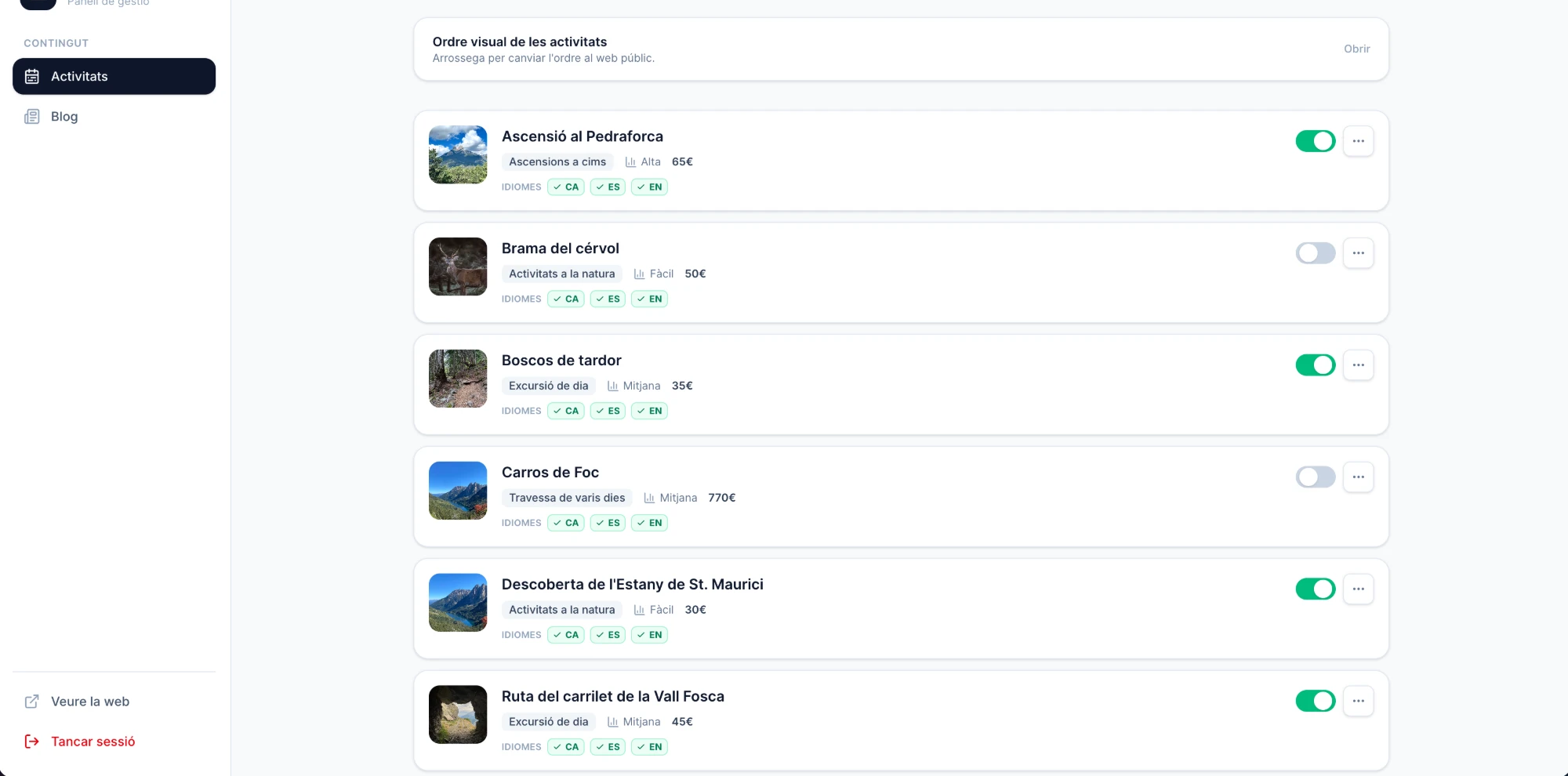
Two pieces of automation keep that workflow light:
- AI-assisted translation. When an activity is created or edited, its content is translated automatically into the other two languages with the Google Gemini API, and the dashboard shows the translation status of every language. The guides write once, in their own language.
- Image processing. Uploaded photos are sent to Cloudinary through its API, compressed and optimised, and served publicly from its CDN, so the guides do not have to prepare images before uploading them.
Architecture and security
There is no separate backend service: the public pages, the dashboard and the server-side routes all live in the same Next.js application. Access control sits in middleware that runs before any protected route. Without a valid session, a request receives neither the private content nor permission to write, so the dashboard and its data stay closed even though they share a deployment with the public site.
SEO
Visibility in search was treated as part of the product:
- each page has its own metadata and canonical URL, and every language has its own URLs;
- the site publishes a sitemap and structured data describing the business, its location and the area it covers;
robots.txtkeeps the dashboard, login and API out of search results while allowing search and AI crawlers to index the public content.
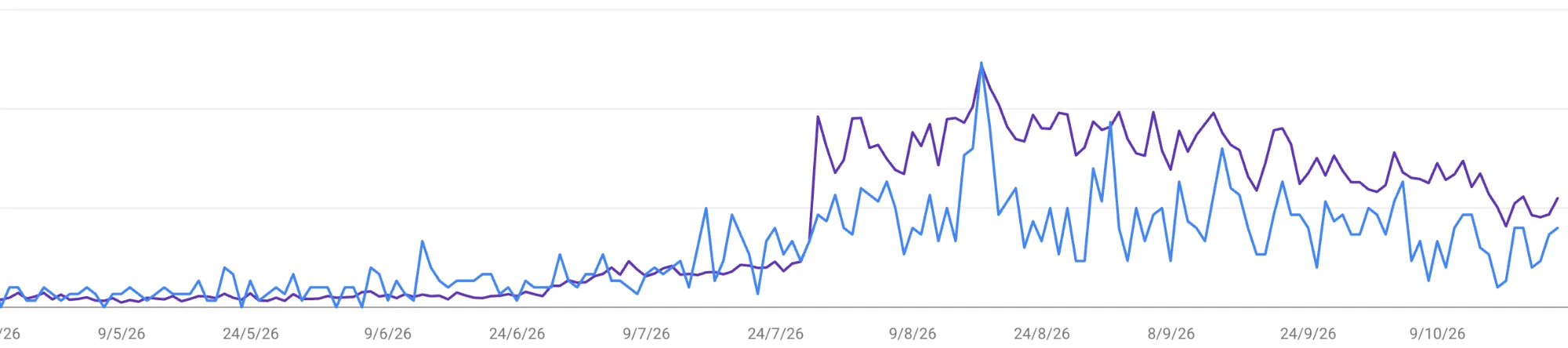
Absolute figures are left out on purpose; the shape of the curve is the point. Demand for guided activities is seasonal, so traffic is expected to rise again with the winter season.